The Beat Goes On
By now, you may have noticed that DAN has been undergoing some changes. In March, our intrepid founder, David, stepped down as a leader because of a move out of state. Since then, we've had a website overhaul, a newsletter move off of Substack (we're on Ghost now), and the leadership group has been working on streamlining us into a more effective "front of house, back of house" volunteer structure. (Technically, we're calling the two groups "Action and Organizing," and "Media and Strategy.")
We're trying to make space for people who both can and want to be out in the streets and for people who can't do street-level volunteering, but can do remote or at-home protest and support. We invite folks to jump back and forth as fits their schedule and abilities. That said, we are actively looking for folks to volunteer to take on small tasks in each group, from drafting social media posts to joining protests on the ground. We still haven't regained our steam from before the holidays and we're hoping to recruit more involvement this summer.
Of course, front of mind right now are the primaries. A lot of Californians are grinding their teeth about the governor's race right now and, here in LA, the inexplicable support of the right wing for...a shiftless blonde reality star with a string of absurd business failures behind him and a decades-long reputation for being entirely unpleasant and unprincipled.
But most of the country is in the cauldron of primary elections right now - and between threats to deploy ICE at the polls, the Supreme Court gutting the VRA, and threats every which way to disenfranchise everyone who isn't a straight white cis man, it's easy to feel that things are only going from worse to worse. Especially when our victories get little air time and feel under constant threat of a rug pull.
It's easy enough to say "this is the time to really lean in," but the truth is that the work for democracy and equity must be a strong, steady push over years and decades and lifetimes. That's a hard truth, yes, but we each have to ask ourselves if we are wholly committed to the project or just uncomfortable with the moment. I invite you to join me in reckoning with the project of a living democracy and to the justice of equal rights and their equitable enjoyment.
It's distressing that the solution in this primary season is "vote harder," but in places like Mississippi, it's going to take bussing people to the polls for days at a time to counteract the disenfranchisement of whole black communities through the closure of polling places and the non-existence of voting by mail. Here in California, the fight is to get people to engage and spend the time to wade through information to make their votes - and then to get those votes into the ballot collection boxes or the mail before June 2 to avoid delays and other chicanery.
This week, though, talk to your communities about whether they've voted, whether they need a voting guide, whether they know what their plan is for submitting their ballot. Offer to go together with someone to the polls before grabbing a cup of coffee or even just to give them a ride. Share reminders that it's best to drop ballots in the mailbox by the 30th. Wear your "I Voted" sticker out and about. For so many people, they noise of the primary simply doesn't penetrate as anything other than a nuisance of junk mail or deeply strange ads. But we should be proud of our right to vote, excited by the prospect, and should never squander our opportunities to be heard.
This week, remind folks that if you don't use your rights, you may very well lose them. But also, remind your friends and neighbors that voting isn't a dirty secret and an inconvenience, but also a way to exercise patriotic participation in this 250-year endeavor of ours to secure liberty and justice for all.
Questions Raised by the SCOTUS Decision in Louisiana v. Callais
by V. Harris, republished with permission
All politics is local. The recent Supreme Court decision gutting Section 2 of the 1965 Voting Rights Act does not just impact Black voters in the old Confederate South. It has national, state and local implications for the mid-terms and beyond.
Elections are an indispensable tool of Indivisible’s goal to push back on Trump’s authoritarian pursuit. MAGA Republicans are rigging the November midterms in light of collapsing popularity in an effort to sustain their congressional majority. Polling demonstrates that GOP disapproval is highest among African American voters. The Callais decision is merely the latest in an on-going strategy of voter disenfranchisement of historically marginalized voters with origins in racial slavery and post-Civil War Reconstruction.
GOP leaders in the South are working at break neck speed to engage in mid-decade redistricting. In the aftermath of Louisiana v. Callais, Elk Grove-Laguna Indy activists must frame conversations about election integrity, voter identification, ballot access, redistricting, campaign finance and political empowerment in ways that build our movement to defend and advance democracy. Such discussions must be rooted in evidence-based practices, facts, accountability, promotion of voter participation and the protection of fair and accessible elections.
Here are five questions to consider in identifying the practical actions local jurisdictions can take regarding the impact of the Callais decision:
1. REDISTRICTING
Will redistricting in Elk Grove and the State of California be impacted by the Callais decision?
2. CHARTER REFORM
Is there language in existing statutes or charters governing counties, municipalities and other local jurisdictions that requires amendment to meet Callais decision standards or that can be amended to minimize the impact on historically disenfranchised communities?
3. JURISDICTIONAL ADVOCACY
How can local jurisdictions like Elk Grove or the Sacramento County Board of Supervisors use their participation in associations like the League of Cities or the County Supervisors Association to advocate for national and state legislation to mitigate the impact of Callais?
4. POLICY AND BUDGET
What policy measures or queries can be undertaken by local officials in anticipation of on-going efforts to erode the voting rights of historically disenfranchised voters?
5. PROGRESSIVE LEADERSHIP
How can progressive leaders provide pragmatic, results-oriented leadership when voting rights are under attack?
The Callais decision is part of a decades-long process to undermine the accumulation and exercise of electoral political power by an increasingly diverse electorate.
The right to vote and the ability to cast a ballot that counts and holds elected officials accountable is too precious for anyone to lose…ever again.
The US-Israel War: A Veteran's Perspective
by DAN Member Informed Voter
It was an unseasonably warm Saturday in February in Los Angeles. I was outside, surrounded by family, setting up for a birthday party taking place that evening. In a moment of rest, taking a break from the heat, I sat down in the shade and hopped onto the New York Times app to check in with the rest of the world. Imagine my surprise and disappointment finding out that the U.S. and Israel began airstrikes against Iran. How did we get here? How did we get from “no new wars” to launching a second round of airstrikes against the Iranians within one year?
Brief History of War in the United States
One of the very important issues the media raised in the early weeks of March was the question of war-making powers and who decides to send the U.S. to war. Constitutionally, the War Powers Clause is found in Article I and is therefore vested in Congress and our Legislative branch. Congress has only utilized its authority to declare war FIVE times in our 250 year history: the War of 1812, the Mexican-American War, the Spanish-American War, World War I, and World War II.
Korea, Vietnam, the Gulf, none of these “wars” were ever officially declared through Congress, making them all “illegal wars.” In 1973 Congress passed the War Powers Resolution to try to limit the Executive’s power to commit U.S. troops overseas. This Act requires the President to notify Congress within 48 hrs of committing forces to an armed conflict and forbids troops from remaining in the conflict passed 60 days without congressional authorization for use of military force (AUMF) or a Declaration of War from Congress. Our 119th Congress has made several attempts to get a resolution passed to reign in Trump’s warmongering in the Middle East, but it failed in the Senate, again. However, we are almost at the 60-day mark, which means, by law, Trump has to get Congressional approval to continue military actions in the region, request an extension, or withdrawal.
While many people have criticized this administration for its “unprecedented nature,” I would bet our U.S. history that it is not. The United States is currently suffering from short-term memory loss, believing the timeline we live in to be like no other before it; but we have had Executive branches who believed themselves to have more power and regarded themselves above the law, especially when it came to international interventions and war. In recent history, Richard Nixon vetoed the War Powers Resolution, believing it was “dangerous and unconstitutional,” but the power of the people was stronger and Congress overrode the veto and passed it anyway. We have a history of American Presidents who act in the gray area of constitutional intent, believing the Executive should have deference over Congress, and it is our responsibility as an informed electorate to elect a Congress that will check that belief.
How Does a War in Iran Benefit the United States?
Getting back to the subject at hand, a war abroad has no benefit for the American people. We have actively spent years, decades in conflicts in the Middle East with just as much time spent working to improve our relationships with those same nations, like Iran. Without going into immense detail, I will just say that the United States and Iran relations have been full of ups and downs over the last century, but we had been moving towards a stable and improved relationship. In 2015, Iran, the United States, and other nations signed the Joint Comprehensive Plan of Action (JCPOA), more commonly known as the Iran Nuclear Deal. That agreement lasted until Donald Trump took office the first time and tore it up because any deal made under President Obama is always a bad deal in Trump’s mind.
Now, we have heard lots of bluster from the Trump administration about why they started this war. “Iran is a nuclear threat, and we have to do everything we can do avoid them from becoming a nuclear power.” The United States already had a nuclear deal in place (again, until Trump pulled out of it), but even still, in June 2025 we claimed to have destroyed their nuclear capabilities when we sent B2 bombers to strike multiple nuclear sites. In the immediate aftermath of that ridiculous “Twelve Day War,” Trump was boasting success at the “obliteration” of Iran’s nuclear capabilities. So, we know it isn’t about nuclear enrichment, arms construction, nor proliferation.
"Iran needs regime change and that’s why we started this war.” Meanwhile, Trump had zero infrastructure in place to execute legitimate regime change: there was no allied coalition of forces going in, there was no discussion prior about the transition period, no support network in place to facilitate regime change. Assassinating the leader of a foreign nation is not “regime change.” True regime change takes a lot of work and buy-in from multiple parties, including the constituents of the nation you want to overthrow. Obviously, Trump’s administration has done ZERO work with the Iranian people to improve relations and get the buy in they needed from the people on the ground.
Which leads to the next lie from Trump 2.0, “We did this for the Iranian people, to support their fight for liberation.” One of the multiple reasons given for launching attacks against Iran was that we did it for the freedom of the Iranian people. This goes back to my previous point: No, this was never the intent because if it actually was, then there would have been cooperation between the Iranians and the United States prior to the attack! Instead, Iranian civilians suffered and died during our airstrikes. They are left to bear the weight and responsibility of this “war.”
“Iran was an imminent threat! They were about to hit us if we didn’t hit them!” Also lies. Iran does not have Intercontinental Ballistic Missiles (ICBMs), nor any other long-range munition to send towards the United States. Iran does not currently pose an imminent threat to the United States, according to Joe Kent, Trump 2.0 Director of the National Counterterrorism Center, who resigned from his position over our decision to get involved with Iran. The only thing Joe Kent and I agree on is the fact that this war was started because of foreign influence.
How Netanyahu Dragged the Unites States in
Now that Donald Trump has pulled the trigger, he can’t put the bullet back in the gun, no matter how hard he tries. The problem with having an imbecilic, dementia-ridden narcissist as the U.S. President is that he will always, always act impulsively in his own “perceived” self-interest. Iran is just another example of an ongoing pattern of foreign leaders exploiting our President by playing to his ego.
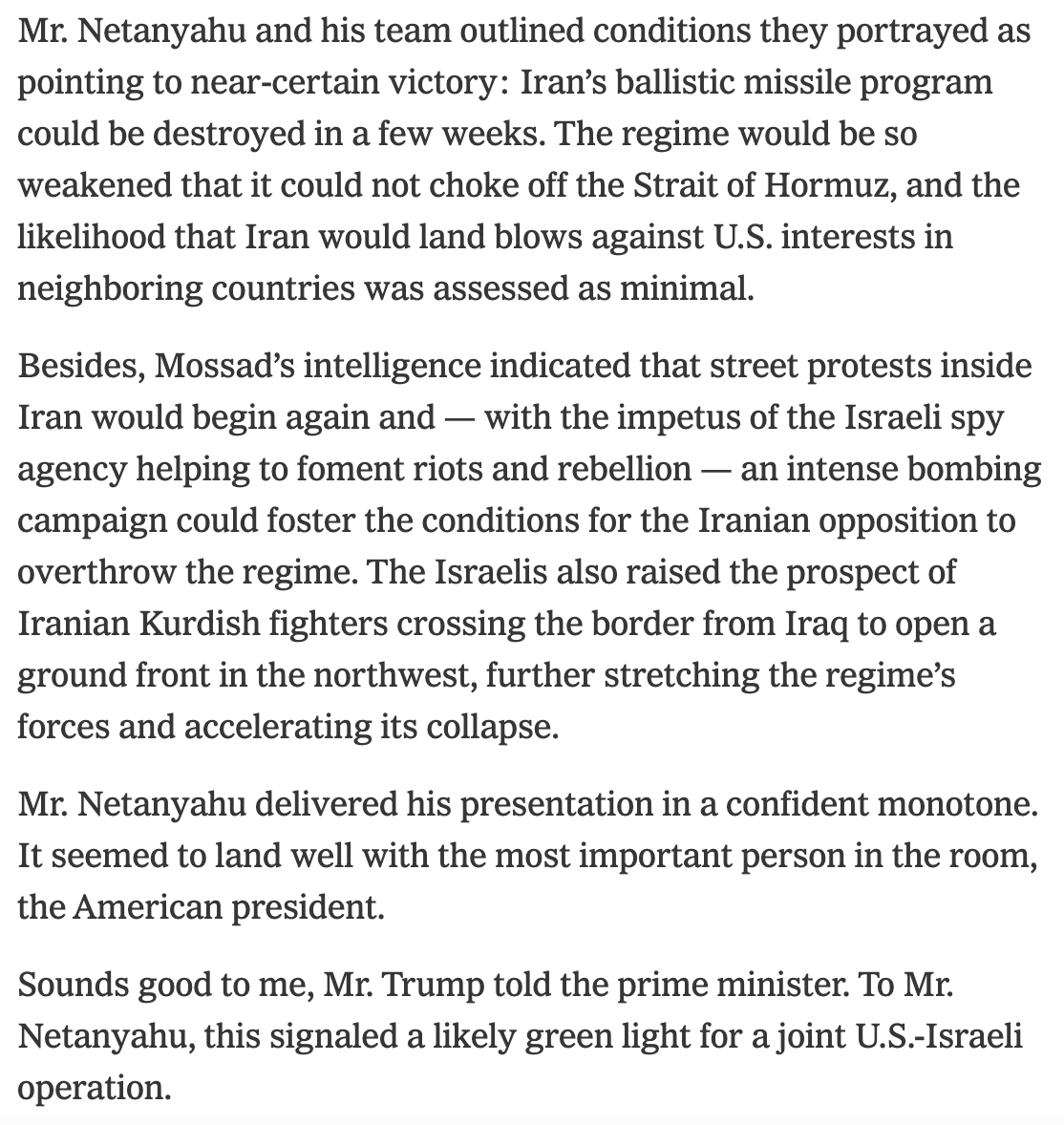
In this scenario, Benjamin Netanyahu has completely used Trump’s ego for the benefit of Israel. Since 1996, Benjamin Netanyahu has been warning the globe that Iran is “weeks away from having a nuclear weapon.” For 30 years, we have been hearing the same rhetoric from Bibi, but the major difference is that now he has a malleable ally in the White House. As we know from NYT reporting, on February 11th Netanyahu was in the Situation Room, with Mossad on the screen, pitching the Iran War to our President.
Who ultimately suffers for the choices made by the men above us? The people. For the Iranians, Israelis, Lebanese, and other civilians on the ground in the region, the cost is enormous; buildings destroyed, daily life altered beyond recognition, death tolls rising. Ultimately, the tens of thousands of civilians are always the ones who bear the brunt of the consequences. Globally, millions of people are suffering from the fallout of the closing of the Strait of Hormuz.
The Ultimate Price
Sweat had started to bead on the top of my brow as we stood at parade rest under the desert sun. It was August 2021 and our Battalion Commander had gathered the unit into a formation so he could address all of us about the withdrawal of US forces from Afghanistan. Most of the NCOs and senior leaders in the ranks served in Afghanistan or knew someone who served in Afghanistan, some even wore memorial bracelets for brothers who never made in back. The level of loss and frustration was palpable, so much so that our Lieutenant Colonel pulled the officers to the side once he released the larger formation. He told us to prepare for the hurt and anger from Soldiers in the coming days and to have empathy for them.
Because, when you strip away the politics and the rhetoric, what remains are the people affected by decisions they never made. Children who went to school not knowing they wouldn’t come home, men who were flown overseas to fight a war they never started, women who are sitting at their desk deciding which bills to pay because the unexpected rising costs of electricity and gas has effectively drained any savings or budget flexibility. This is the cost of war and politics, and the cost affects all of us globally.
The best advice I can offer to anyone who is feeling lost about how to best fight back: follow the money. Find out which companies are investing in warmongering and boycott them. Check out the campaign finance data of the candidates running in your area and donate to the candidate not backed by the military industrial complex. Find resources about becoming a War Tax Resistor if you don’t want your taxes to be spent on war. The only thing politicians listen to is money, so hit them in their pocketbooks and remember to always vote in every election because a single vote does make a difference.
Additional Resources for the Primaries:
A few of the voting guides out there to make informed, pro-democracy, and pro-working-family choices.
Blue Voter Guide , Cal Matters , Streets for All , La Defensa , SAJE , LA Forward , DSA , Knock LA
Candidate updates and news - Cook Political Report
Non-partisan candidate guides - Ballotpedia
Track your mail-in ballot - BallotTrax
California Election Codes - FindLaw
Know Your Voting Rights 101 - ACLU California Action
Election Hotlines available in English, Spanish, Arabic and other languages Election Protection Hotline (National)