The 2025 Elections: Seven Lessons on the Myth of Realignment and the Permanence of Economic Anxiety
How Democrats Swept the States and What It Reveals About American Politics
In F. Scott Fitzgerald’s unfinished novel The Last Tycoon, the protagonist Monroe Stahr observes that “there are no second acts in American lives.” The 2025 elections suggest we might need to revise that famous aphorism for our current political moment. It turns out there are second acts in American politics—they just arrive far more quickly than anyone anticipated, and they tend to involve voters changing their minds with remarkable speed about whoever currently holds power.
On November 5th, 2025, Democrats swept statewide races from Virginia to New Jersey with margins that shocked even the most optimistic party strategists. Governor-elect Abigail Spanberger won Virginia by fourteen points. Mikie Sherrill kept New Jersey blue by a double-digit margin. Georgia, that perpetual political battleground, delivered two statewide wins for Democrats, flipping both Public Service Commission seats for the first time in recent memory. Pennsylvania Democrats held all their Supreme Court seats and won a lower court race. And in what may be the most symbolically resonant result of the evening, a democratic socialist named Zohran Mamdani became mayor of New York City.
These results didn’t just outperform expectations. They fundamentally challenged the prevailing narrative that had dominated political analysis since Donald Trump’s 2024 victory. That narrative, advanced by Republican pollsters and embraced by anxious Democrats, held that Trump had engineered a fundamental realignment of American politics, building a durable multiracial working-class coalition that would dominate elections for years to come. The 2025 results suggest something quite different: that we’re living through an era of profound electoral volatility driven not by ideological realignment but by economic anxiety so pervasive and persistent that voters will punish whoever happens to be in charge when they check their bank accounts.
To understand what happened on November 5th, and what it portends for the 2026 midterms and beyond, we need to examine seven data-driven lessons that emerge from the wreckage of Republican hopes and the unexpected strength of Democratic performance. These lessons, drawn from comprehensive exit polling and precinct-level analysis, paint a picture of an electorate that is deeply unsettled, remarkably pragmatic, and far less interested in ideological positioning than the professional political class would have us believe.
Lesson One: The Universal Shift Toward Democrats
There’s a moment in Tolstoy’s Anna Karenina when Levin realizes that what he thought was a local phenomenon on his estate is actually occurring across all of Russia. Something similar happened to political analysts on election night 2025. What initially appeared to be isolated Democratic over-performance in a few counties revealed itself to be a nationwide wave.
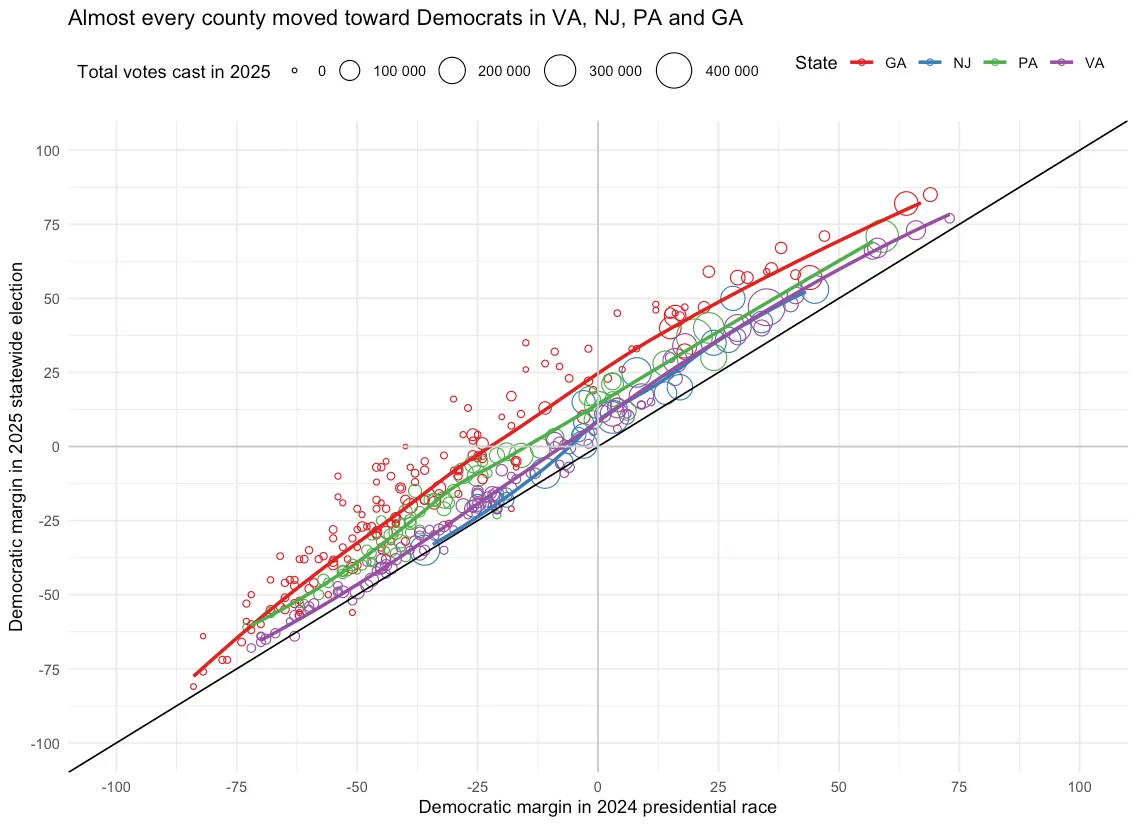
Most of the graphs in this essay are from G. Elliott Morris’s Strength in Numbers Substack.

99.8% of counties shifted toward Democrats from 2024 to 2025With few exceptions, voters everywhere moved left. Democratic candidates for governor, court seats, and utility positions performed better than Kamala Harris did in 2024 across Georgia, New Jersey, Pennsylvania, and Virginia.This was a directional shift that transcended geography, demographics, and local political conditions.
The numbers are staggering. In 99.8 percent of counties that held partisan elections, voters moved to the left from 2024 to 2025. This wasn’t a matter of Democratic strongholds getting slightly bluer or competitive suburbs shifting a few points. This was a directional movement so comprehensive that it transcended geography, demographics, and local political conditions. Democratic candidates for governor, court seats, and even municipal utility positions performed better than Kamala Harris had in 2024 across Georgia, New Jersey, Pennsylvania, and Virginia.
To put this in historical perspective, we need to return to the language of political science and what constitutes a genuine electoral realignment. Political scientists typically identify three requirements for a realignment:
- A large swing against the party in power (not the modest six-point margin Trump achieved in 2024, but something closer to ten or fifteen points),
- Significant subgroup realignment (four or five demographic groups moving twenty to thirty points in a consistent direction),
- And most crucially, durability.
The shifts have to stick. They have to represent something more fundamental than a momentary reaction to circumstances.
By this standard, Trump’s 2024 victory was never a realignment. It was an anti-incumbent election driven by inflation and economic discontent. What we witnessed in 2025 was the same dynamic operating in reverse, with one critical difference: the swings were larger than the thermostatic backlash typically produces. Virginia shifted sixteen points from its 2021 gubernatorial race and nine points from the 2024 presidential results. This suggests something beyond simple reaction—it suggests genuine repudiation.
The universality of the shift matters because it undermines the persistent temptation to find local explanations for national phenomena. Yes, Jack Ciattarelli was a weak candidate in New Jersey. Yes, Abigail Spanberger ran an exceptionally strong campaign in Virginia. But when 99.8 percent of counties move in the same direction, we’re looking at forces larger than individual candidate quality or campaign tactics. We’re looking at a fundamental shift in how voters perceive economic stewardship and political accountability.
Lesson Two: Democrats Can Win Regardless of Turnout
One of the more persistent anxieties among Democrats over the past year centered on the possibility that their apparent strength in special elections was merely an artifact of superior turnout machinery in low-participation contexts. Since January, Democrats had been flipping state legislative seats from Iowa to Mississippi, running ahead of Harris’s 2024 vote margin by an average of fourteen points. But many of these contests featured shockingly low turnout, sometimes less than ten percent of registered voters.
The concern was understandable. If Democratic strength existed only in races where motivated base voters could overwhelm a disengaged Republican electorate, then the party’s prospects in higher-turnout contests like the 2026 midterms would be far more uncertain. The 2025 gubernatorial races put that theory to the test.
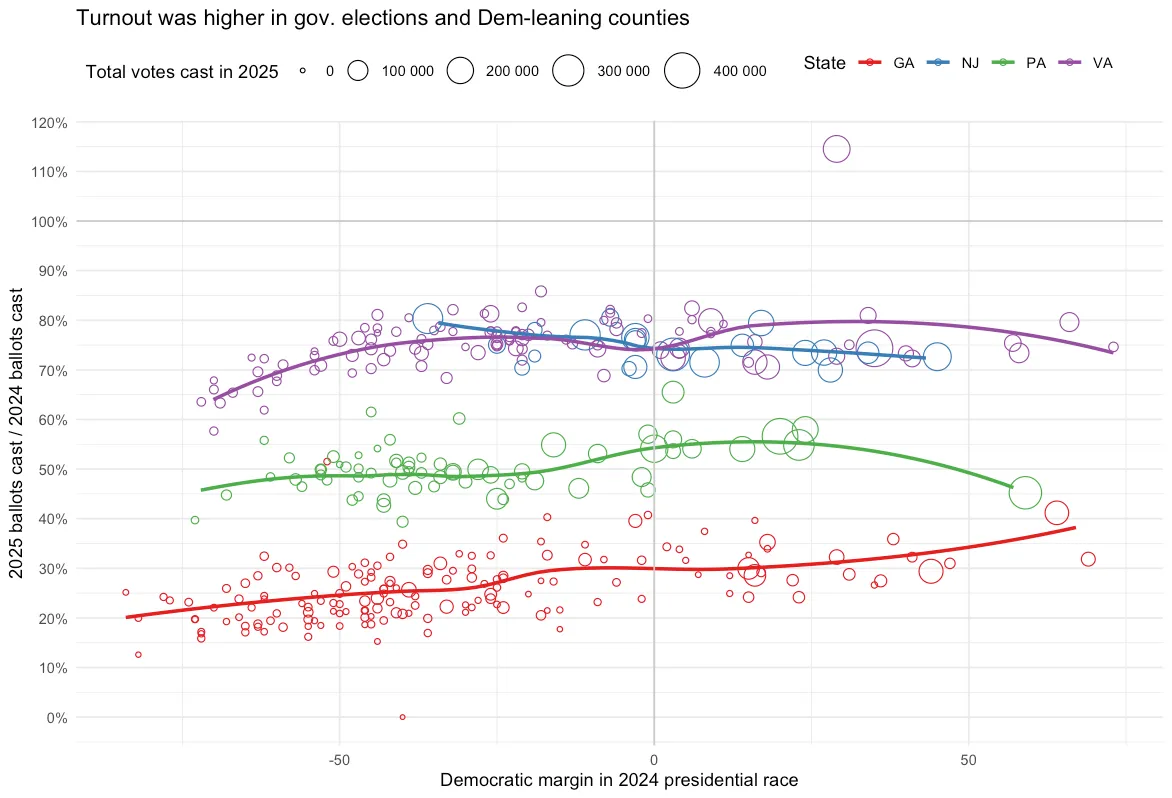
In Virginia and New Jersey, average turnout reached approximately eighty percent of 2024 presidential election levels. For an off-off-year election, this is exceptional. Some counties, like Henrico in Virginia, actually cast more votes than they had in the presidential contest. Yet the Democratic swing in these states still reached seven to eight points. Georgia, which featured lower turnout races for Public Service Commission seats, did see slightly larger Democratic margins, but the difference wasn’t dramatic enough to suggest turnout was the determining factor.
Dispelling the “Special Election” Theory
Virginia & New Jersey:Approximately 80% of 2024 turnout levelsStill delivered 7-8 point Democratic swingsSome counties (like Henrico, VA) exceeded 2024 turnout
Georgia:Lower turnout environmentDemocrats still saw significant gains in state utility races
The Verdict: Evidence of both persuasion effects and turnout mobilization. Democrats can win regardless of turnout level.
The implications here are significant for understanding contemporary political dynamics. We’re seeing evidence of both persuasion effects (actual voters changing their minds) and differential turnout (one party’s supporters showing up in greater numbers). The exits and early voter file analysis from New Jersey suggest about five points of persuasion and three points of turnout advantage for Democrats. That’s a healthy mix, and it suggests the Democratic coalition isn’t merely energized—it’s actually growing through conversion.
This should inform how we think about the 2026 midterms. Democrats won’t need to achieve presidential-year turnout to perform well. They’ll need solid turnout combined with persuasion of genuinely persuadable voters, particularly those who voted for Trump in 2024 because of economic concerns but have since soured on his performance. According to exit polling, seven percent of 2024 Trump voters in both Virginia and New Jersey voted for Democratic gubernatorial candidates in 2025. That’s not an overwhelming number, but in an era of narrow margins, it’s more than sufficient to flip elections.
Lesson Three: The Ninety-Three Point Economy Swing
If you want to understand the 2025 elections in a single number, it’s ninety-three. That’s the number of percentage points that economy-focused voters shifted from supporting Trump in 2024 to supporting Democrats in 2025. It’s the kind of swing that makes you check your math twice, then check it again, then wonder if perhaps democracy itself has become fundamentally unmoored from any stable preferences whatsoever.
Economy-Focused Voters: 93-Point Swing to Democrats
2024 Election:Trump +63 among voters who prioritized the economyEconomy voters: 63% for Trump, 37% for Harris
In 2024, voters who identified the economy as their top issue supported Trump over Harris by a sixty-three point margin. These voters—who constituted roughly forty-eight percent of the Virginia electorate and thirty-two percent in New Jersey—were the bedrock of Trump’s electoral coalition. They weren’t particularly interested in his positions on immigration or cultural issues. They wanted lower prices, and they believed Trump could deliver them. In this, they proved mistaken.
By 2025, these same economy-focused voters were supporting Democratic gubernatorial candidates by a thirty-point margin. The arithmetic is straightforward but the implications are profound. Trump won in 2024 almost entirely because of his advantage on economic issues. By 2025, that advantage had not merely evaporated—it had reversed into a crushing disadvantage.
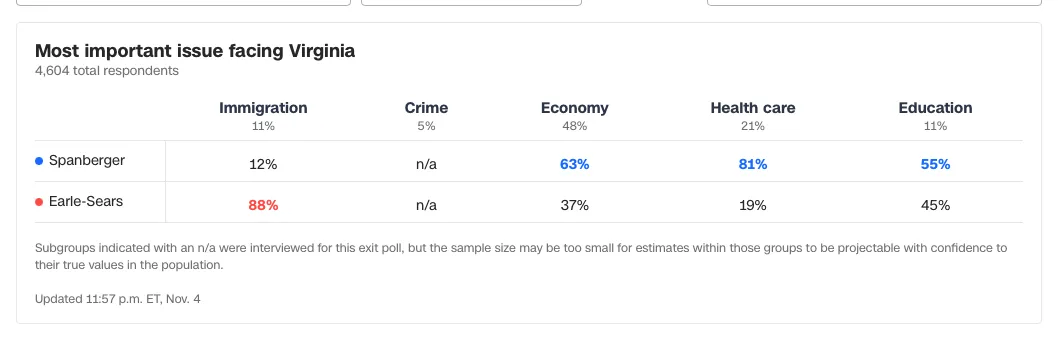
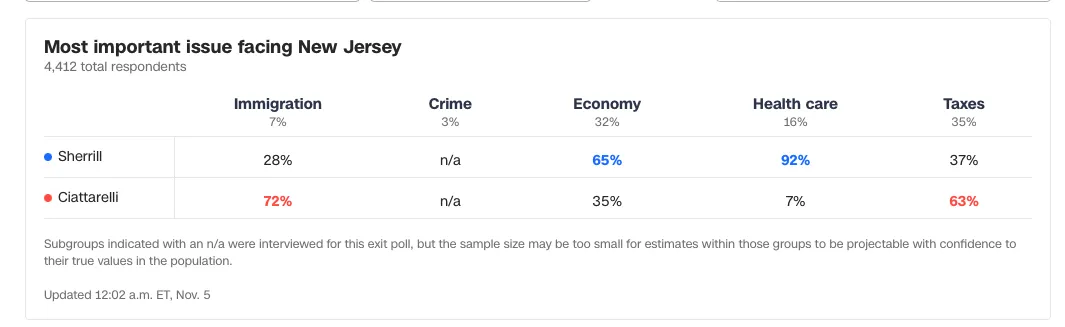
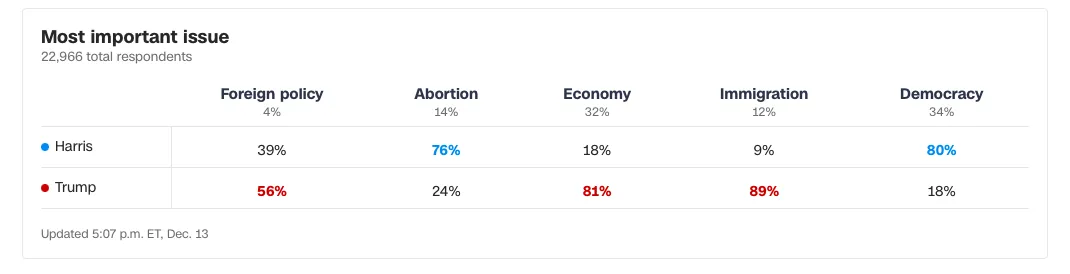
The exit polling offers further texture to this story. When asked what issue mattered most to them, roughly forty-eight percent of Virginia voters and thirty-eight percent of New Jersey voters cited the economy or taxes. Twenty-one percent mentioned healthcare. Meanwhile, immigration—the issue Republicans had hoped would save them—was cited by only eleven percent, and that group remained roughly as pro-Republican as it had been in 2024. The share of voters naming immigration as their top concern actually fell in New Jersey compared to the previous year.
2025 Election:Democrats +30 among the same voter groupEconomy voters: 62% for Democratic candidates, 38% for Republicans
Total Movement: 93 percentage points
Inflation alone accounts for about 90% of the swing between parties from 2024 to 2025. The reason Trump won in 2024 was his lead on the economy. Now, Democrats have the advantage.
This returns us to a fundamental insight about American politics that periodically gets obscured by more sophisticated-sounding theories about ideology and realignment. As James Carville famously put it in 1992, “It’s the economy, stupid.” When voters feel economically secure, they can afford to consider other factors in their political choices. When they feel economically anxious, everything else fades into background noise.
The Biden administration lost in 2024 not because of any particular policy failure on immigration or social issues, but because inflation had made voters feel economically insecure and they blamed the party in power. The Trump administration is now facing the same dynamic, with one important difference: Trump made explicit promises about bringing down prices that he has manifestly failed to keep. His tariff threats have, if anything, worsened inflation expectations. His immigration enforcement, whatever its other effects, hasn’t made groceries more affordable. His healthcare proposals threaten Medicare and Medicaid, which millions of Americans depend on.
Inflation alone, according to the analysis, accounts for about ninety percent of the swing between the parties from 2024 to 2025. This is political science at its most elegant and depressing. Voters aren’t responding to sophisticated arguments about policy trade-offs. They’re responding to the very simple question of whether their economic situation has improved or deteriorated under the current leadership. Right now, they believe it has deteriorated under Trump, and they’re punishing Republicans accordingly.
Lesson Four: Affordability Messaging Transcends Ideology
Here’s where things get interesting for those of us who have spent the past year watching Democrats engage in an increasingly tedious and circular debate about whether the party needs to move toward the center or embrace its progressive wing more fully. The 2025 elections offer a definitive answer to this question: the question itself is wrong.
Consider three winners from election night. Abigail Spanberger in Virginia, generally understood as a moderate Democrat who alienated the AFL-CIO during her campaign. Mikie Sherrill in New Jersey, also running as a moderate with an emphasis on fiscal responsibility and public safety. And Zohran Mamdani in New York City, a self-described democratic socialist who ran on free public transit and aggressive rent control. All three won decisively. Spanberger and Sherrill both captured roughly fifty-six to fifty-seven percent of the vote. Mamdani won his race handily against a far more conservative opponent.
Three Winners, Same Message, Different Ideologies
Abigail Spanberger (Moderate):Virginia Governor-electWon by 14 points (56-57% of vote)Focused on affordability and economic relief
Mikie Sherrill (Moderate):New Jersey Governor-electWon by 11 points (56-57% of vote)Emphasized cost-of-living concerns
Zohran Mamdani (Democratic Socialist):New York City Mayor-electRan on affordability platformFree public transit, rent control proposals
The common thread wasn’t their position on some imagined left-right ideological spectrum. It was their relentless, almost monotonous focus on affordability and economic relief, tailored to the specific concerns of their constituencies. Spanberger talked about lowering healthcare costs and providing tax relief to working families. Sherrill emphasized property tax reform and affordable housing. Mamdani promised free buses and trains and challenged landlords raising rents. Different policies, different ideological frameworks, identical core message: I will make your life more affordable.
This should be obvious, but it apparently needs repeating because so much political commentary continues to treat American elections as ideological referenda. The reality, as political scientists have known for decades, is that most voters have remarkably little understanding of where candidates stand on specific issues, and even less understanding of what ideological labels like “moderate” or “progressive” actually mean.
A 1964 study by Philip Converse found that only about ten percent of the American public could meaningfully distinguish between liberal and conservative issue positions. More recent work by Nathan Kalmoe and Donald Kinder at the University of Michigan finds essentially the same thing in contemporary data: roughly eighty percent of Americans cannot reliably map policy positions onto ideological labels. They’re not ideologues. They’re pragmatists asking a simple question: will this candidate make my life better?
What I’m calling the “strategist’s fallacy” is the tendency of political professionals to assume that voters think about politics the way strategists do—as a matter of carefully weighing issue positions and ideological commitments. In reality, most voters are consuming political information sporadically at best (about fifty percent of Americans engage with political news less than monthly), and they’re making decisions based on broad impressions about authenticity, competence, and alignment with their economic interests.
This explains how Trump could win young men in 2024 despite an extremely unpopular agenda that those voters disagreed with on most specific issues. It also explains how Democrats could win across the ideological spectrum in 2025 by focusing on the one thing voters actually care about: economic relief. The leverage point in American politics isn’t ideological positioning. It’s economic credibility.
Lesson Five: The Vanishing Trump Coalition
If you were constructing a political realignment narrative in late 2024, you would have pointed to Trump’s gains among Hispanic voters, young voters, and working-class voters as evidence of a fundamental reshaping of American electoral coalitions. Republican pollster Patrick Ruffini made precisely this argument, suggesting Trump had built a durable multiracial working-class coalition that would dominate politics for years to come. Many Democrats believed him.
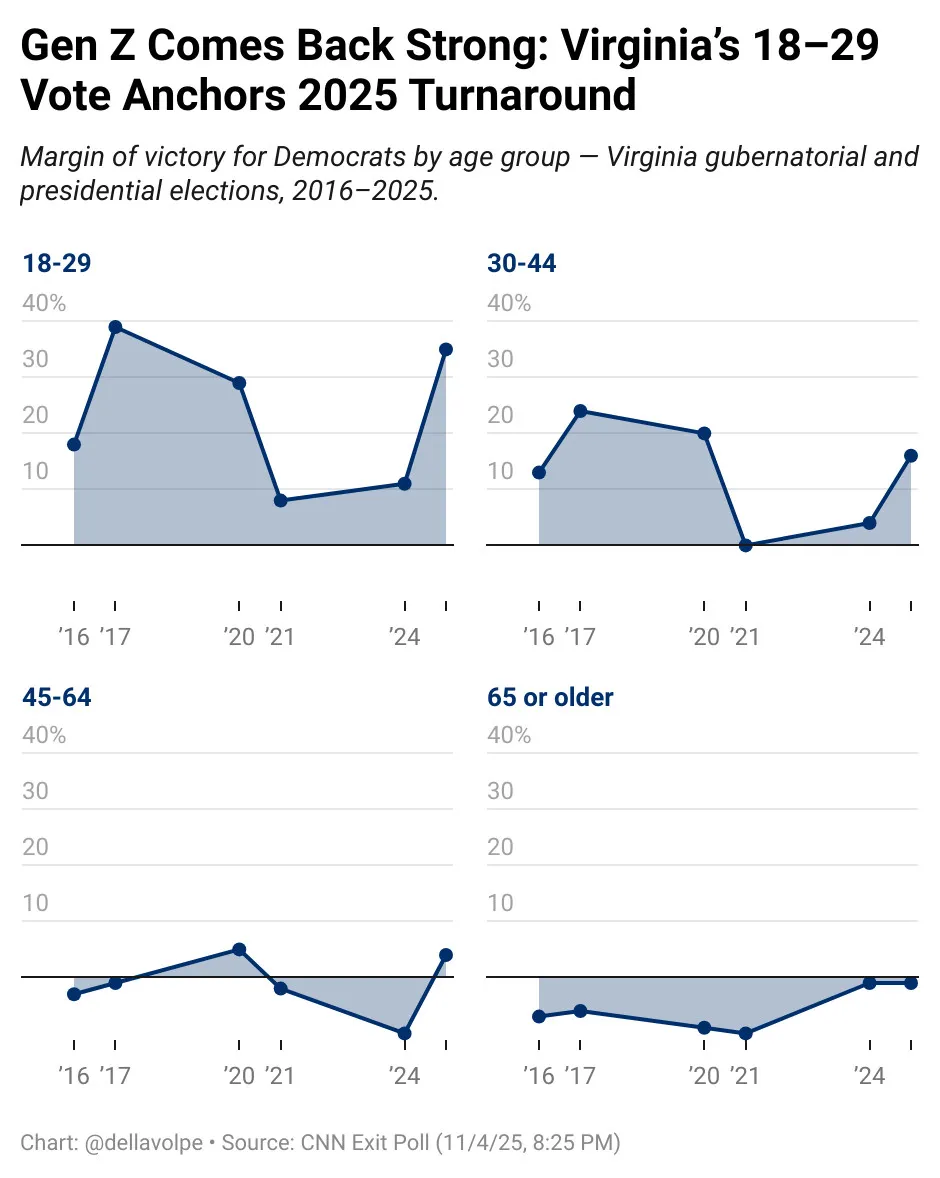
The 2025 elections exposed this as wishful thinking, or at minimum, dramatically premature. The groups that supposedly powered Trump’s realignment moved back to Democrats with remarkable speed. Young voters shifted twenty-two points in the Democratic direction. Hispanic voters moved twenty points. Asian American voters in Virginia shifted a staggering forty-two points. Voters making less than fifty thousand dollars a year moved eighteen points back toward Democrats. Meanwhile, white voters—the traditional Republican base—moved only five points, the smallest shift of any demographic group.
The Groups That Supposedly Powered Trump’s 2024 Coalition Have Reversed
Young Voters (18-29):22-point shift back to DemocratsVirginia: Spanberger won by 35 points (vs Harris +10 in 2024)
Hispanic/Latino Voters:20-point shift back to DemocratsUnion City, NJ (82% Hispanic): 53-point swing from Harris’s 17-point margin to Sherrill’s 70-point marginWith HIGHER turnout than 2024
Asian American Voters:42-point shift back to Democrats in Virginia
Lower-Income Voters (<$50k):18-point shift back to Democrats
White Voters:Only 5-point shift (smallest movement)
The most dramatic example comes from Union City, New Jersey, a municipality that is eighty-two percent Hispanic. In 2024, Kamala Harris won Union City by seventeen points, with roughly eighteen thousand votes cast. In 2025, Mikie Sherrill won the same city by seventy points—technically 68.8, if you want to be precise about it—with higher turnout than the presidential election. That’s a fifty-three point swing in a single year, with more people voting.
This kind of movement is too large to explain through sampling error or turnout differentials. These are actual voters changing their minds, and they’re changing their minds because the thing they cared about most—economic improvement—hasn’t materialized under Trump. The supposed realignment was always, in political science terms, a matter of “retrospective economic voting.” Voters weren’t embracing Trump’s ideology or his policy agenda. They were punishing the incumbent party for inflation. When Trump became the incumbent party and inflation didn’t improve, those voters punished him instead.
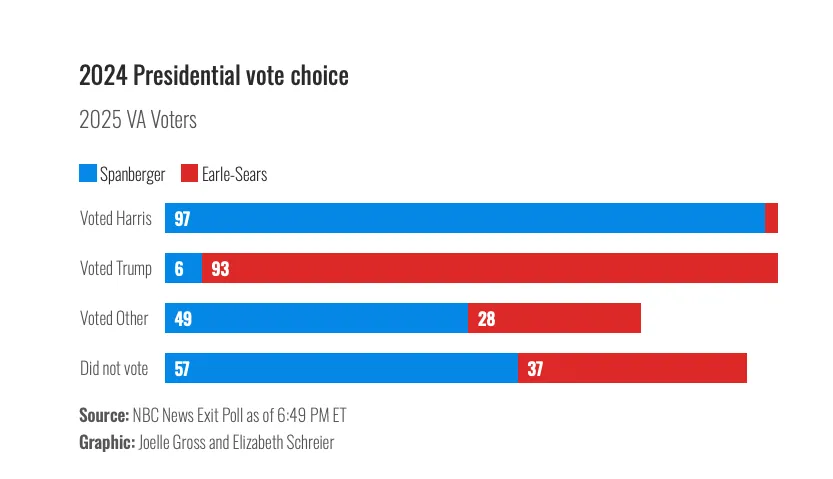
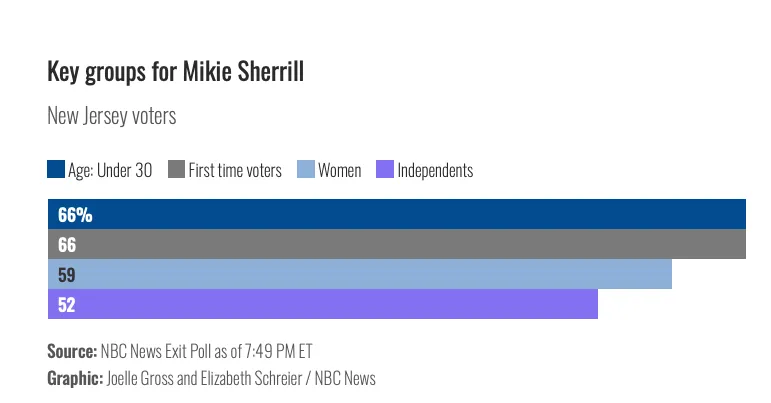
The exits show this with painful clarity. Seven percent of people who voted for Trump in 2024 voted for Democratic candidates in 2025, in both Virginia and New Jersey. Among voters who didn’t participate in 2024 but showed up in 2025, Democrats won by a two-to-one margin: sixty-six percent to thirty-three percent. Among non-white voters, lower-income voters, and young voters—the core of Trump’s supposed realignment—the shift back to Democrats was far larger than the overall electorate movement.
Historical analogies are imperfect, but this pattern most closely resembles the false realignment claims that followed other anti-incumbent elections. In 1980, Ronald Reagan’s victory over Jimmy Carter was initially interpreted as a conservative realignment, a fundamental shift in American political preferences toward smaller government and traditional values. Within two years, Democrats had picked up twenty-six House seats in the 1982 midterms. The “realignment” had been greatly exaggerated. Voters hadn’t become conservative. They’d become frustrated with Carter’s handling of the economy and gave Reagan a chance. When Reagan’s policies initially struggled, they moved back.
The difference between a genuine realignment and an anti-incumbent swing is durability. Realignments persist across multiple election cycles. They represent fundamental changes in how groups of voters understand their interests and align themselves with parties. The New Deal realignment lasted decades. The Reagan coalition, to the extent it existed, persisted through the 1980s. Trump’s supposed multiracial working-class coalition lasted less than a year.
Lesson Six: What Virginia Tells Us About 2026
Virginia’s gubernatorial elections have developed an unusual reputation in American politics. Because they occur in odd-numbered years, one year after presidential elections but one year before midterms, they often serve as early indicators of the national political environment. Political scientists have documented that when one party does particularly well or poorly in Virginia’s gubernatorial race, that party tends to perform similarly in the subsequent midterm elections.
The relationship isn’t perfect—we’re working with a small sample size of recent elections—but the pattern is strong enough to warrant attention. Since 2009, the swing in Virginia’s gubernatorial race from the previous presidential result has correlated reasonably well with the next House midterm outcome. And Spanberger’s fourteen-point victory, representing a sixteen-point swing from Glenn Youngkin’s 2021 win, suggests an environment for 2026 that looks something like Democratic plus-eight to plus-nine in the House popular vote.
Virginia as a Bellwether for 2026 Midterms
Historical Pattern: Since 2009, Virginia’s gubernatorial race swing predicts the subsequent House midterm performance. Spanberger’s 15-16 point improvement over 2021 results suggests strong Democratic environment.
The Projection: House popular vote margin of D+8 to D+9 in 2026
Caveat: Margin of error of about 4 points in either direction (range: D+4 to D+13)
Key Factors:Trump approval rating: 41% (and trending down)Economic sentiment remains sourTrump’s policy agenda is historically unpopular7% of 2024 Trump voters in VA/NJ voted Democratic in 2025
House Outlook: Democrats very likely to win majority
Senate Outlook: 28-30% chance for Democrats (up from near zero)
To put this in context, current generic ballot polling shows Democrats ahead by only three to four points. If the Virginia bellwether holds, Democrats could expect their advantage to grow by roughly five points over the next year, driven by the same historical pattern that sees the party out of power gain ground in public opinion as the midterm approaches. This would put them at plus-eight to plus-nine, nearly identical to what the Virginia results suggest.
The margin of error on this kind of projection is substantial—approximately four points in either direction, which means the actual result could range from Democratic plus-four to plus-thirteen. But even the low end of that range would likely result in Democrats winning the House majority. The high end would represent a wave election comparable to 2006 or 2018.
Several factors support the more optimistic interpretation for Democrats.
- First, Trump’s approval rating currently sits at forty-one percent and trending downward. For reference, that’s identical to Viktor Orbán’s approval rating in Hungary—a comparison that should trouble anyone concerned about democratic erosion.
- Second, Trump’s policy agenda remains historically unpopular across virtually every major issue area.
- Third, the economic sentiment that drove voters to Republicans in 2024 has shifted back against them, with roughly fifty-three percent of Americans consistently saying the economy is getting worse since the pandemic.
- Fourth, and perhaps most importantly, there’s evidence of meaningful persuasion occurring among Trump’s own voters.
That seven percent defection rate in Virginia and New Jersey, if replicated nationally, would be devastating for Republicans in competitive districts. Consider that most House races are decided by margins far smaller than seven points. If Democrats can maintain even a fraction of these gains while also benefiting from the traditional midterm backlash against the presidential party, they’re positioned for significant gains.
The Senate presents a more complicated picture. Democrats would need to defend several vulnerable seats while also flipping Republican-held seats in traditionally red states. The analysis puts their chances at roughly twenty-eight to thirty percent—far better than the near-zero probability before the 2025 elections, but still requiring considerable luck and strong candidate recruitment. Still, even that modest probability represents a dramatic shift in outlook from late 2024, when Democrats appeared headed for a multi-cycle minority in both chambers.
One crucial caveat: all of this assumes conditions remain roughly similar to what they were in November 2025. If Trump somehow manages to improve the economic situation, or if some external crisis reshapes the political landscape, all bets are off. But absent such dramatic changes, the fundamentals point toward a difficult midterm for Republicans.
Lesson Seven: The Polling Errors and What They Reveal
There’s a particular kind of smugness that overtakes political commentators when polls prove inaccurate. It’s satisfying to point out that the professionals got it wrong, that all their sophisticated methodology and careful weighting couldn’t capture what was actually happening on the ground. But the reality of polling errors is both more interesting and more instructive than simple stories about broken models or biased pollsters.
Polls Underestimated Democrats by Normal Amounts, But in Opposite Direction from Recent Cycles
The Results:Virginia: 2-3 point miss (better than 4-point average)New Jersey: 6 point miss (worse than 4.5-point average)Overall: About same magnitude as 2024 errors, but favoring Democrats
Why the Errors Occurred:
Problem: Weighting by Past Vote
Many pollsters adjusted their samples to match the 2024 presidential electorate. This artificially included too many Trump voters who either:Didn’t show up in 2025Switched to voting Democratic
The Lesson: In off-year elections, pollsters should NOT weight to match the previous presidential election’s electorate. The composition changes significantly.
Who Got It Right:YouGov: D+14 in VA, D+11 in NJ (nearly perfect)FiftyPlusOne: Better than other aggregatorsBoth used proper likely voter models instead of past vote weighting
The 2025 elections saw polls underestimate Democratic performance by roughly the same magnitude that they underestimated Republican performance in recent presidential cycles—about two to three points on average. In Virginia, polls were off by two to three points in Democrats’ favor, which is actually better than the four-point average error for off-year gubernatorial races in that state. In New Jersey, the miss was larger, approximately six points, which exceeds the historical average of 4.5 points. Overall, the magnitude of error was normal. What changed was the direction.
This matters because it undermines one of the more persistent myths in political analysis: that polls have a systematic bias in favor of Democrats. Over the past three presidential cycles (2016, 2020, 2024), polls did indeed underestimate Republican performance, by an average of 2.7 to 3 points at the state level. This led to widespread hand-wringing about the “broken” state of polling and suggestions that something fundamental had changed about who responds to surveys. Some pollsters began making adjustments specifically designed to correct for this perceived Republican undercount.
In 2025, those adjustments backfired. Pollsters who had weighted their samples to match the 2024 presidential electorate systematically underestimated Democratic strength. The reason is straightforward: the 2025 electorate was different from the 2024 electorate. Many Trump voters simply didn’t show up for off-year races. Others who did show up changed their votes. By forcing their samples to match 2024’s partisan composition, pollsters were artificially including too many Trump voters and depressing Democratic margins.
YouGov, which came closest to the actual results with projections of Democratic plus-fourteen in Virginia and plus-eleven in New Jersey, avoided this error by weighting their full sample of registered voters to demographic benchmarks, then applying a likely voter screen on top of that. This allowed them to naturally capture the changed composition of the electorate rather than forcing it to match an outdated baseline. The lesson here isn’t complicated: in off-year elections, don’t weight your polls to match the previous presidential election’s partisan composition.
But there’s a deeper issue at play, one that goes beyond technical details about survey methodology. The polling industry has developed an unhealthy obsession with avoiding the specific errors of the most recent election, which often leads them to over-correct and commit new errors in the opposite direction. After underestimating Republicans in three straight presidential cycles, many pollsters became paranoid about underestimating them again. So they adjusted their methods to ensure more Republican voices in their samples. Then the electorate shifted, and suddenly they were overestimating Republicans instead.
This is reminiscent of what military theorists call “fighting the last war”—preparing so thoroughly for the challenges you previously faced that you become vulnerable to new and different challenges. The polling industry would benefit from acknowledging a basic truth: political environments change, electorates shift, and no methodology will be consistently accurate across all contexts. The best polls use transparent, rigorous methods that can adapt to different non-response environments. The worst polls chase the specific sources of error from the previous cycle and get blindsided by new problems.
There’s also the question of partisan polls deliberately skewing averages. In the weeks before the election, a number of Republican-affiliated polling firms released surveys showing much tighter races than independent polls suggested. These partisan polls, which often use questionable methodologies and implausible crosstabs (one firm showed Black voters in New Jersey supporting the Republican candidate 60-40, which would represent a seventy-point swing from typical voting patterns), had the effect of moving polling averages in a Republican direction and creating false narratives about momentum.
The aggregator FiftyPlusOne, which adjusted for pollster house effects and partisan data, consistently showed larger Democratic leads than RealClearPolitics or other averages that included these partisan polls without adjustment. In the end, FiftyPlusOne’s averages proved more accurate, suggesting that the old approach of simply averaging all polls together regardless of quality or partisan sponsorship has become inadequate in an era where political actors deliberately attempt to manipulate polling averages.
The Strategist’s Fallacy and the Two-Dimensional Electorate
During the interview portion of the podcast with Paul Krugman that accompanied this analysis, Elliott Morris advanced a framework for understanding American politics that deserves extended consideration. He calls it the “strategist’s fallacy,” and it explains a great deal about why political professionals so frequently misunderstand the voters they’re trying to reach.
The Strategist’s Fallacy
Why the “Moderate vs Progressive” Debate Misses the PointThe Fallacy: Political strategists assume voters decide based on candidates’ ideological positions and issue stances. They map their own decision-making process onto the median voter.
The Reality:80% of Americans cannot distinguish liberal vs conservative issue positionsMost voters don’t know candidates’ specific policy positions50% of Americans consume political news less than monthlyVoters respond to authenticity and economic messaging, not ideology
The fallacy works like this: Political strategists think about politics in terms of issue positions and ideological labels. They debate whether candidates should be more moderate or more progressive, whether they should emphasize economic populism or cultural traditionalism, whether they should move left on this policy or right on that one. And because they think this way, they assume voters think this way too. They map their own decision-making process onto the median voter and conclude that elections are won by carefully calibrating positions on a left-right ideological spectrum.
But most voters don’t think about politics this way at all. They don’t know candidates’ positions on most issues. They don’t understand what ideological labels mean. And they certainly don’t spend time carefully weighing the relative merits of different policy proposals. About eighty percent of Americans, according to research by political scientists Nathan Kalmoe and Donald Kinder, cannot reliably distinguish between liberal and conservative issue positions. These aren’t ignorant or uninformed people. They’re people with jobs and families and lives that don’t revolve around consuming political news and tracking legislative debates.
Morris suggests we need a different model for understanding how voters actually behave.
- Instead of a one-dimensional left-right spectrum, think of a two-dimensional space.
- The horizontal axis still represents ideology, from left to right.
- But the vertical axis represents political engagement, from highly engaged at the bottom to politically disengaged at the top.
The voters who matter most in determining election outcomes aren’t the ones at the far left or far right of the ideological spectrum. Those voters have firm commitments and aren’t persuadable. The voters who matter are in the top portion of this two-dimensional space: disengaged or semi-engaged voters who have loose ideological attachments and are primarily concerned with whether the government is delivering for them economically.
Trump won these voters in 2024 not by moving to the ideological center but by speaking to their economic anxieties with simple, direct promises about lowering prices. Democrats won them back in 2025 by making equally simple, direct promises about economic relief—again, without necessarily moving to some hypothetical ideological center. The leverage point isn’t left versus right. It’s engaged versus disengaged, and the currency is economic credibility.
Understanding Anti-Incumbent Politics: It’s the Economy, Not the Ideology
The Pattern:2024: Democrats lose because they’re in power during inflation2025: Republicans lose because they’re in power during continued economic pessimismThis is NOT a realignment in either direction
Economic Sentiment:53% of Americans say economy is getting worse (since pandemic)This pessimism hurts whoever is in chargeConsumer sentiment at financial crisis levels despite better economic indicators
Trump’s Approval:41% and falling (same as Viktor Orbán in Hungary)30 points underwater on handling inflationWorse than Biden’s numbers during 2022 inflation crisis peak
The Bottom Line: When more than 25-30% of people say the economy is worsening, the incumbent party will lose. It’s that simple.
This framework helps explain several otherwise puzzling features of recent American politics. It explains how Zohran Mamdani, an avowed democratic socialist, could win New York City’s mayoral race in the same year that moderate Democrats won gubernatorial races in Virginia and New Jersey, all by running on affordability. It explains how Trump could win young men despite their disagreement with his positions on most social issues. It explains why the endless Democratic debate about moderation versus progressivism has produced so little clarity—the debate itself is premised on a misunderstanding of how most persuadable voters actually think.
The New York Times editorial board, in a widely discussed piece after the 2024 election, argued that Democrats need to moderate their positions to win back working-class voters. The piece didn’t mention inflation as a factor in Kamala Harris’s defeat even once. This is the strategist’s fallacy in action: assuming that electoral outcomes are determined by ideological positioning rather than by external conditions like economic performance that neither party fully controls.
The reality, as the 2025 elections demonstrate, is messier and less ideologically satisfying. Voters aren’t sending clear signals about what they want Democrats or Republicans to do. They’re expressing frustration with whoever is in charge when times are tough. They’re punishing incumbents for economic conditions. And they’re willing to vote for candidates across the ideological spectrum as long as those candidates credibly promise to improve their economic situation.
California’s Exception and Why It Matters
Not every election in 2025 followed the pattern of dramatic Democratic gains. California’s Proposition 50, a redistricting measure that would have favored Democratic seat gains, passed with a margin of sixty-four to thirty-six—essentially matching Joe Biden’s 2020 performance and slightly outperforming Kamala Harris’s 2024 showing. This might seem like a contradiction to the broader narrative of Democratic surge, but it actually reinforces the core lesson about when economic swings matter and when they don’t.
The Result: Prop 50 passed 64-36, matching Biden 2020 and outperforming Harris 2024 (59-41)
Why Different from Virginia/New Jersey?Partisan ballot measure in safe Democratic state without economic messaging campaign equals partisan result. Virginia swung 16 points because competitive gubernatorial race activated economic concerns. California reverted to partisan baseline because redistricting measure asked straightforward party preference question.
Lesson: Economic swings require competitive races and economic messaging. Without those conditions, partisan defaults win.
For 2026: Focus resources on competitive races where economic messaging can override partisanship, not ballot measures in safe territory.
California voters weren’t being asked to evaluate economic performance or choose between competing visions of economic policy. They were being asked a straightforward partisan question: do you want the electoral map drawn in a way that helps Democrats win more seats? In the absence of competitive gubernatorial campaigns that activated economic concerns, California voters reverted to their stable partisan preferences. Democrats in a heavily Democratic state voted for a Democratic-favoring redistricting plan. This is what you’d expect.
The contrast with Union City, New Jersey—also heavily Democratic, also predominantly Latino—is instructive. Union City swung fifty-three points toward Democrats in a gubernatorial race centered on economic messaging and affordability. The difference wasn’t the underlying partisanship of the voters. It was whether economic concerns were activated by the specific electoral context. Partisan ballot measures in safe states produce partisan results. Competitive races with economic messaging produce economic-driven swings.
This distinction matters enormously for understanding how to allocate resources and set realistic expectations for 2026. Economic swings aren’t automatic. They require specific conditions: competitive races where voters are making choices between candidates, intensive messaging that activates economic concerns, and an electorate of genuinely persuadable voters with loose partisan attachments. In safe Democratic or Republican territory, or in races about abstract structural questions rather than concrete governance, you shouldn’t expect 2025-style swings.
What Grassroots Activists Should Actually Do
If you’re involved in grassroots organizing—whether through Indivisible, local Democratic clubs, or any of the other vehicles through which engaged citizens channel their political energy—the 2025 elections offer clear guidance about where to focus your efforts. The ninety-three-point swing among economy-focused voters isn’t just a data point. It’s a roadmap.
DAN can apply these insights:Frame Electoral College reform: “Coastal elites ignoring Midwest” → “Your vote should count as much as anyone’s + here’s how it hurts your wallet”Frame Supreme Court reform: Not “they’re too partisan” → “They’re blocking economic relief you need”Frame democracy reforms: Not “norms matter” → “When the system’s rigged, your voice on bread-and-butter issues doesn’t count”
But Be Cautious About:Over-relying on economic determinism (movements need moral energy too)Ignoring the 20% who ARE ideological (they’re your volunteer base)Assuming 2026 will automatically favor Democrats without the organizing work
First and most fundamentally, lead with economic messaging in every interaction with voters. This doesn’t mean abandoning other issues. It means understanding that economic concerns are the entry point to every other conversation. When you’re discussing healthcare, emphasize costs and affordability. When you’re addressing climate change, highlight green jobs and lower energy bills. When you’re talking about immigration, connect it to labor rights and fair wages. Economic messaging doesn’t close doors to other topics. It opens them.
Second, stop re-litigating the moderate versus progressive debate. The 2025 results should have settled this once and for all. Spanberger, Sherrill, and Mamdani represent dramatically different positions on the traditional ideological spectrum, but they all won by focusing relentlessly on affordability tailored to their specific communities. The question you should be asking about potential candidates isn’t where they fall on some imagined left-right spectrum. It’s whether they can credibly promise to deliver economic relief and whether voters will believe them.
Third, recognize that your best persuasion targets aren’t voters who care deeply about ideological consistency. They’re disengaged or semi-engaged voters who are economically anxious and have loose partisan attachments. These voters respond to authenticity and concrete proposals, not to carefully calibrated policy white papers. Keep your economic messaging simple, direct, and connected to their lived experience. Talk about prices, wages, housing costs, and healthcare bills. Skip the complex policy details.
Fourth, start building for 2026 now. The political environment looks favorable—potentially Democratic plus-eight to plus-nine—but favorable environments don’t translate into electoral victories without candidates ready to run and organizations prepared to support them. Focus particularly on local economic races that directly impact people’s daily lives. Georgia’s success in targeting Public Service Commission seats that control electricity prices should be your model. Identify utility boards, housing authorities, school boards, and other local positions where you can make concrete economic differences.
Fifth, use Trump’s unpopularity strategically but specifically. His forty-one percent approval rating gives you permission to persuade voters who might otherwise be reluctant to vote Democratic. But don’t just run against Trump in the abstract. Connect his unpopularity to concrete local economic failures.
- Show how his tariffs have raised prices in your community.
- Document how his immigration policies have disrupted local businesses.
- Demonstrate how his healthcare proposals threaten Medicare benefits your neighbors depend on.
Make the national political story locally relevant.
What should you not do? Don’t assume the favorable environment will last without work. Don’t get complacent about turnout just because Democrats achieved eighty percent of presidential-year participation in Virginia—that required massive field operations. Don’t ignore the seven percent of Trump voters who switched to Democrats in 2025—your economic messaging can reach them, but only if you actually try. And don’t abandon democracy messaging entirely, but understand that for most persuadable voters, economic concerns will be more immediately salient than abstract concerns about democratic norms.
The 2025 elections have given you a gift: empirical evidence about what works. Democrats across the ideological spectrum won by focusing on affordability and economic relief. That’s the message. That’s the strategy. Everything else is details.
The Myth of Realignment and the Reality of Volatility
There’s a certain comfort in the language of realignment. It suggests that beneath the chaos of individual elections, deeper patterns are forming. It implies that we can identify durable coalitions and predict future outcomes based on fundamental shifts in how groups understand their interests. It offers the possibility that politics is ultimately comprehensible, that we’re moving toward some new stable equilibrium even if we can’t quite see its shape yet.
The 2025 elections should disabuse us of that comfort. What we’re living through isn’t a realignment in any direction. It’s something potentially more unsettling: a period of profound electoral volatility driven by economic anxiety so persistent and widespread that voters will punish whoever holds power when they check their grocery bills.
Debunking the 2024 Realignment Theory
What a Real Realignment Requires:Large swing against incumbent (10-15+ points, not 6)Subgroup realignment (4-5 groups moving 20-30 points)Durability - the shifts STAY (this is the key test)
Trump’s 2024 “Realignment” Failed All Three Tests:
Test 1 - Size: 6-point popular vote margin is modest by historical standards
Test 2 - Subgroups: While some groups moved (Latinos, young voters), they were smaller shifts than claimed
Test 3 - Durability: FAILED. Within one year:25-point average reversal among “realignment” groupsLarger-than-average anti-incumbent swingComplete evaporation of supposed gains
The Real Story: 2024 was an anti-incumbent election driven by inflation. 2025 was also an anti-incumbent election. The common thread is economic anxiety, not ideological realignment.
Implication: Neither party has a durable majority coalition. We’re in an era of volatile, economically-driven swings.
Consider the speed at which supposed realignments have evaporated. After Trump’s 2016 victory, analysts proclaimed the death of the Obama coalition and the rise of a new Republican majority built on white working-class voters. Then Democrats won back the House in 2018 with a large swing in the suburbs. After Trump’s 2024 victory, we heard about a multiracial working-class realignment that would dominate politics for a generation. That “realignment” lasted less than a year before evaporating in the face of continued economic pessimism.
The historian Richard Hofstadter once wrote about “the paranoid style in American politics”—the tendency to interpret political events through grandiose narratives about fundamental threats and revolutionary changes. Perhaps we need a companion essay about “the realignment style in American politics”—the tendency to interpret electoral outcomes as evidence of deep structural shifts when they might simply reflect voters’ frustration with whoever is currently in charge.
The political science is actually quite clear on this. When economic sentiment is sour, voters punish the incumbent party. When economic sentiment improves, voters reward the incumbent party. The party ID of the incumbent matters less than the economic conditions they’re presiding over. This isn’t a new insight. V.O. Key wrote about retrospective voting in the 1960s. Christopher Achen and Larry Bartels have demonstrated that voters punish incumbents for events entirely outside their control, including droughts and shark attacks. The idea that elections are primarily referendums on recent economic performance is one of the most robust findings in all of political science.
What’s unusual about our current moment isn’t the existence of retrospective economic voting. It’s the persistence of economic pessimism despite relatively solid objective indicators. Consumer sentiment remains at levels typically associated with major recessions, even though unemployment is low and GDP growth has been positive. Roughly fifty-three percent of Americans have consistently said the economy is getting worse since the pandemic, regardless of which party controls the White House or what the economic data actually show.
This creates an environment where no governing coalition is stable. Democrats lost in 2024 because they were in power during inflation. Republicans are losing in 2025 because they’re now in power during continued economic pessimism. If this pattern persists—and there’s no reason to think it won’t, given the structural economic challenges facing younger generations around housing costs, education expenses, and stagnant real wages—we may be entering a period where control of government regularly shifts back and forth based not on ideological preferences but on pure anti-incumbent sentiment.
The comparison to other democracies is sobering. In 2024, incumbent parties lost across the developed world, regardless of their ideology or policy approaches. The average swing against incumbents globally was about twelve points. The United States, with a six-point swing against Democrats, actually saw less anti-incumbent movement than average—though that’s cold comfort to those who believed the American electorate was sending some unique message about progressive politics or Democratic Party strategy.
If we’re indeed entering an era of permanent electoral volatility driven by economic anxiety, the implications are troubling. Governance requires some degree of stability and predictability. Long-term policy challenges like climate change or infrastructure investment or debt management require sustained attention across multiple election cycles. If every party in power can expect to lose dramatically in the next election simply because economic pessimism persists, the incentives for serious governance collapse. Why invest political capital in solutions that won’t pay off until after you’ve lost power?
This is the real lesson of 2025, and it’s bleaker than simple stories about realignment or thermostatic backlash. We’re not cycling between two competing visions of American governance. We’re cycling between different groups of disappointed voters, all of them angry that the economy isn’t working for them, none of them patient enough to give any governing coalition time to address structural problems.
Conclusion: Democracy in an Age of Economic Anxiety
There’s a scene in George Orwell’s Homage to Catalonia where he describes the collapse of revolutionary unity in Barcelona as economic conditions deteriorated. The grand ideological commitments that had brought people together dissolved in the face of immediate material concerns about food and safety. Politics, Orwell realized, ultimately rests on a foundation of basic economic security. Take away that security, and everything else becomes unstable.
The Bottom Line
Voters care about affordability and freedom. Democrats who focus on that message - whether they’re moderates or progressives - are winning.
The Economic Story: The economic and electoral conditions of 2024 have cleared, and people are reacting to what they’ve actually seen from Trump and the Republican Party. When the economy isn’t delivering for the average voter, Americans vote out the party that holds power.
The Polling Story: Polls do not always overstate support for Democrats. Basing polling methodology on that premise will eventually backfire.
The Strategic Story: Stop debating moderate vs progressive. Start delivering on economics.
Looking Forward: If current conditions persist - economic pessimism, Trump unpopularity, failure to deliver on affordability - 2026 will likely see significant Democratic gains. But volatility is the new normal. Neither party can count on durable coalitions.
The 2025 elections are telling us something similar about contemporary American democracy. When voters feel economically secure, they can afford to consider questions about democratic norms, social values, and long-term policy direction. When they don’t feel economically secure—when they’re worried about paying rent or buying groceries or affording healthcare—everything else becomes secondary. Democracy and authoritarianism, progressivism and conservatism, all of it fades into background noise behind the simple question: who can make my economic situation better?
This should trouble anyone who cares about American democracy, because it suggests that Trump’s historically low approval rating and the unpopularity of his authoritarian tendencies are primarily driven by economic disappointment rather than principled opposition to democratic backsliding. The comparison to Viktor Orbán is instructive: Orbán maintained power in Hungary by improving the economy while systematically dismantling democratic institutions. If Trump could deliver economically, many voters would likely overlook his attacks on democratic norms.
The 2025 results show Democrats winning decisively, but they also show the limits of anti-authoritarian messaging. Exit polling indicates that while economic concerns drove roughly forty-eight percent of Virginia voters and thirty-eight percent of New Jersey voters, concerns about democracy and civil rights—while present—were far less salient for most persuadable voters. This doesn’t mean democracy isn’t important. It means that for voters who aren’t already politically engaged and committed to democratic principles, economic security takes precedence over everything else.
Looking ahead to 2026, Democrats are positioned well if current conditions persist. The Virginia bellwether suggests a potential eight- to nine-point advantage in House races. Trump’s approval remains underwater. Economic pessimism continues. The ingredients for a Democratic wave are present. But they’re present not because voters have embraced the Democratic Party’s vision or rejected Trumpism on principle. They’re present because voters are still angry about the economy and they’re taking it out on whoever currently holds power.
This is democracy operating as designed, in one sense. Voters are holding leaders accountable for conditions they don’t like. But it’s also democracy operating in a degraded mode, where accountability is largely backward-looking and reactive rather than forward-looking and aspirational. We’re not choosing between competing visions of the future. We’re punishing whoever we held responsible for the disappointing present.
The seven lessons from the 2025 elections all point in the same direction. Universal county movement toward Democrats: that’s anti-incumbent sentiment. Success in both low and high turnout: that’s broad dissatisfaction cutting across engagement levels. The ninety-three-point economy swing: that’s pure retrospective voting. Affordability messaging working across ideologies: that’s confirmation that voters care about material conditions, not ideological labels. Trump’s vanishing coalition: that’s the realignment that never was. Virginia predicting Democratic success in 2026: that’s the anti-incumbent pattern extending forward. Polling errors in Democrats’ favor: that’s evidence the electorate shifted faster than anyone expected.
Seven Lessons for Understanding American Politics in 2025Universal Movement: 99.8% of counties shifted Democratic - this was nationwideTurnout-Independent: Democrats win in both low and high turnout contextsEconomy Dominates: 93-point swing among economy voters tells the whole storyAffordability Transcends Ideology: Moderate and progressive Democrats both won with economic messagingNo Realignment: Trump’s 2024 gains evaporated completely within one year2026 Implications: Virginia results project D+8 to D+9 environment for midtermsPolling Lessons: Weighting to past presidential vote in off-years underestimates change
The Meta-Lesson: Stop over-interpreting ideological signals. Voters are responding to economic conditions and punishing incumbents who don’t deliver. It’s anti-incumbent politics driven by persistent economic pessimism.
If you’re looking for deeper meaning or durable coalitions or evidence of fundamental ideological shifts, you won’t find them in these results. What you’ll find is an electorate that is angry, anxious, impatient, and willing to give anyone a chance if they promise to improve economic conditions—but equally willing to abandon them within a year if those promises don’t materialize.
The question facing both parties isn’t how to position themselves on some imagined left-right spectrum. It’s how to actually deliver economic relief and security to voters whose pessimism has become so entrenched that it persists regardless of objective conditions. Until someone figures out how to solve that problem, we’re likely to continue cycling through these anti-incumbent waves, punishing whoever has the misfortune of holding power when voters check their bank accounts and find them unsatisfactory.
That’s not a realignment. That’s not even politics as usual. That’s democracy in an age of persistent economic anxiety, and it’s far less stable than anyone should be comfortable with.